
Everyone is 12 Now
On attention and the worst instagram reel I've ever seen.

My favorite meme (or, I guess theory) of 2026 or ever is that “everyone is twelve now”. Never has one sentence so perfectly encapsulated the current state of human affairs. It comes from the following tweet by probably-moniker Patrick Cosmos:
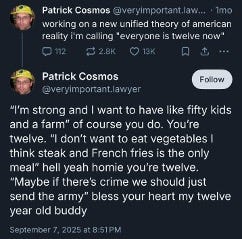
The tweet itself speaks most directly to the cultural and political landscape of the USA: its leaders in position and voice, those who follow them, and the decisions being made upon façade-driven ideologies, thus amplifying a neo-traditional, missing-the-point, ironically-anti-pageantry conservative lens. Just as importantly, I’d argue “everyone is twelve now” speaks to how people behave…in general. It’s the basis for how a frighteningly high-percentage of humans, American and otherwise, are acting in a look-at-me era both propagated-by and representative-of the attention economy.
With the idea that attention-seeking is becoming less shamefully the most important thing – uber-ironically so for those who prophet for hyper-masculine lifestyles while also needing and thriving off external validation to soothe insecurities, in turn steering the curation of their outward persona – lost in the matrix is the skill of deciphering: good attention vs. bad attention.
This is a lesson that most people are taught, or at least were previously taught, aptly, around the age of 12.
Attention is currency, and in 2026, this currency is considered as or more valuable in online life, which in turn can lead to financial currency; albeit, for many the notoriety, validation, and new sense of purpose in being acknowledged online is worth the effort in-and-of-itself. I see this represented every year in my high school students’ responses to “what do you want to be when you grow up?” Predominantly for the boys, the answers are between TikTok/YouTube/streamers if not in the NBA or NFL. If I ask them what they want to be famous for online, they don’t care, they just want to be known. When I pry more, I realize they most all have parasocial relationships with streamers, feeling like they know the creators as friends.
Parasocial relationships were once limited to known celebrities, but depending on how we consider the definition of celebrity, anyone can be a celebrity now. Also, previously, there were thicker boundaries, more privacy, less of the illusion of accessibility. The belief that anyone a celebrity now is real for so many people that we see behaviors in-person (IRL) existing for the expression of an online identity, contrary to earlier stages of social media use where the online platform is an extension, an added bonus to our IRL experience: flair to amplify connections contrary than existing as the connection. As of writing, yesterday I went to see Da Vinci’s Last Supper. As soon as we walked into the room where it’s painted on a wall, several people took photos of one another in front of the painting, a few selfies, and then immediately left. I watched them not pause for even a moment to witness and explore the painting itself despite offering detailed feedback on arm and torso positioning in order to be perfectly centered under Jesus for the photo.
I took a ‘Media & Society’ class in undergrad that hypothesized in dystopian fashion, amongst lectures of oligopolies and political manipulation strategies, that at some point in the future online life would supersede IRL as the real life. The University of Iowa Communications and Media Studies department nailed it. As did David Foster Wallace in many of his musings about the exponentially progressive reliance on entertainment as a numbing agent.
Jake Paul. I’m assuming you know who he is. I bet you felt something come up just from reading the name. Most people reading this can agree Jake Paul got famous for being an asshole, which he then leveraged into a whole career of low-quality, low-thought output which is now amounting to actual political influence and power therefore exponentially exacerbating the very qualities that made him an asshole to begin with. In the not-too-distant past, in order to become a household name celebrity, one needed to possess extraordinary talent or beauty (more or less). Otherwise, 15-minutes of fame might platform a person before the inevitable retreat to normalcy. Social media and algorithm constructs have created interminable lasting power for the once-15-minutes-of-fame. As we’re more online, nothing goes away, no one goes away, every flash of mass-attention currency transforms into an entrepreneurship portal. This mentality in the online space leads to exceptional levels of grifting, a posturing as authority without adequate (or any) valid credentials. Take Nick Fuentes or your run-of-the-mill-agitator-with-a-microphone content creator or podcaster, for example. Or the people who interview drunk strangers on the street. People to talk directly into the camera within any industry: health, beauty, business, politics. The loudest voices likely don’t care about you or your growth from their message. They don’t care about whether their advice or opinions are tried and tested. They don’t care about the domino effects of their rhetoric. What they care about is themselves, their content, and optimizing algorithmic and psychological manipulation to keep your gaze on what they’re sharing, championing the individualist, neoliberalist view that all corners of life are a marketplace to be won. Without teachers or actual respected authority figures at the head of the classroom, you get an ecosystem of 12-year-olds shouting over one another, copying each other’s work, all claiming they know what’s best; a Dunning-Kruger peak uplifted in perpetuity with a reward-system discouraging acquisition of actual knowledge.
I had the unfortunate experience of having an Instagram reel pop up on my feed that haunts me daily. I can’t stop thinking about it, it’s maximalism, flamboyance, and aggressiveness in its boyishness. It comes from an account called “biggroove”, a 40-something Nigerian-American man named Clive Ibizugbe. He has 2.2 million followers and an account with reels of 10+, 20+, and 30+ millions of views. I saw his face once and he lives with me forever, rent free, paid off mortgage in dead center of my temporal lobe.
Clive, is, most obviously from first look, an exceptionally large human presumably with a past or active role as a professional bodybuilder. The video which cursed my phone screen begins with him standing at a fast food counter in a white [whatever-the-appropriate-term-for-wife-beater-shirt is] and cut-off jean shorts, holding an oversized oven-pan tray containing three Philly cheesesteaks, two more cheesesteaks in novelty extra-large size, a massive portion of onion rings and French fries, two Tasty Kakes, and a bag of potato chips. With his massive muscles fully exposed, he powerfully chops and stomps his feet, makes silly, bizarre facial expressions drawing attention to a crunched forehead and exposed upper gums, and rolls his head and neck in a whip several times before lugging the platter which probably weighs more than a newborn to a table.
He unhinges his massive jaw, exposing unusually large and impressively white teeth, gazing at the meat in awe as he barks like a seal while reaching for a cauldron of melted cheeze-whiz. He gleefully ladles globs of the orange goo over his sandwiches before grabbing one in his hands, closing his eyes, tilting his head to the heavens, and shouting “SHARK BITE” as the cameras pans into an extreme close-up of a gargantuan chomp directly, chaotically, into the middle of the sandwich. He rolls his eyes toward the back of his skull in bliss, stands up, spreads the wings of his comically large muscles, walking back to the counter, and initiating a maniacal choreographed dance routine as he keeps a stern face, still holding the unchewed Philly in his mouth, trying not to choke or projectile softened beef morsels at the cameraman as he bounces around spasmodically.
Aside from footage from Gaza, it is the worst thing I have ever seen on my phone. After perusing his page, I realize this is fully his brand, it’s what he does: candy, burgers, hot pot, etc..
As a piece of advertisement, I ask: what the fuck? What a terrible time to have eyes.
As a piece of entertainment, I ask: who is this for? At first, I wondered if the intended audience was small children, but that can’t be the case because kids don’t have social media accounts, or at least in theory shouldn’t with the current terms of service. Then, begrudgingly, I considered the racial component. It’s never, ever a good idea to criticize expression of Black joy – not sure how authentically joyous this reel was, but still – though it’s hard not to feel some minstrel-like yuckiness about an adult man in his 30’s shamelessly acting like a sub-12-year-old while selling out his integrity for online views and sliced beef on bread.
Bullying is bad, to be clear, but this type of behavior, in the real world, once “policed itself. In a polite way, we can call it feedback, social accountability. If someone behaved like Clive, or Nick Fuentes, or Jake Paul*, they’d become a social pariah. People wouldn’t want to hang or opt willingness to be around this level of behavior, it would be an embarrassment. Then, after some time, and hopefully some healthy chats, they might change behaviors, grow, mature, learn a lesson about how to exist. But online, instead, people just shove a camera in front of the person. Positive reinforcement. Immediate dopamine blast. This will go viral! Money, money, money! No reflection, a capitalization on social defects, arrested development in the name of personal brand expansion.
*Granted, it’s always been true that having wealth and influence can buy people out of behaving appropriately, it acts as a blinder for character defaults to those who jealously aspire for wealth themselves or secretly hope that wealth will be shared by proximity. Few else can explain why the people with the most power and influence in politics are the most insecure dorks, hellbent on revenge. *
I have a due diligence to figure why I was so bothered, why I hate this reel so deeply in pits of soul with a cringe that brings physical pain. After all, I’m the one who made the decision to watch the whole thing in its entirety, and then a second time for the essay. It’s my brain that keeps thinking about it. It was my decision to spend time on Instagram while waiting for my next class to start.
I’m going to make some assumptions here based on visible factors. Here we have a man who likely pays rent or has a mortgage, adult things that assume real responsibilities. He’s probably experienced, love, loss, and pain at points in his life. He is also obscenely large with a low enough body fat that you can see the striations and insertions of his muscles with thick, flush vascularity. This means he has a strong grasp on discipline in how he treats his physique – he understands the lessons and payoffs of sacrifice, commitment, and work ethic. To get that big, he needs to eat a lot of protein, 300+ grams daily for someone his size. This is extremely expensive. As someone who has experimented with weight fluctuations in my life, the biggest limiting factor towards having larger muscles for myself and many others is the cost and time commitment – this man is spending hours and hours in the grocery store and kitchen each week, and if not, a ton of money to eat out. Lastly, to keep it real, the man has a level of skill. The dance moves he’s pulling off, while definitively bad, take coordination, proprioception, and athleticism.
There was a phase in pop culture some years ago about embracing one’s inner child, a rebellion against the monotony of the adult life, a call back to being playful and creative, a skill that society and late-stage-capitalism beats out of us as we age. Bullshitting is part of what makes life worth living and I back this call-in fully and wholeheartedly, though I’m not sure Clive’s antics, especially as they exist for the camera, is at the heart of the movement. All this to be said the hate is still mostly visceral, uncomfortable. I feel gross watching it. I teach 10–12 year-olds as a day job and I’ve see them grow out of this behavior, and if not, they’re encouraged by the adults in the room to tone it down, to respect common spaces.
I feel guilty. I don’t want to be too hard on Clive. I’m sure he’s a great person when not shilling fast food and acting like a doofus on the internet. Shoutout to Nigerian-Americans. In my experience, having grown up with, worked with, and taught amongst hundreds, they are maybe the most respectable and cool people pound-for-pound, which makes the spectacle even more jarring. If we zoom the lens back, this type of content isn’t really hurting anybody, unlike decision makers in politics who want the same love and attention yet are eager to inflict harm to get it; those who lack having developed empathy. The oversaturation of look-at-me content is making us dumber, more shameless, sure, but at least it’s not at the direct expense of anyone’s wellbeing; it creates no suffering. He’s just a big-ass dude being silly and having fun.
There’s something for me to learn, here. Whenever I post something on the internet, I’m aware of how many (how few) eyes will see it, so if I share something, I want it to have meaning, some sort of value. I overthink it. I delete Instagram stories an hour after posting more often then I let them sit for 24 hours, especially the edgier ones that leave me feeling uneasy with anxieties: what if someone from work sees this and I get called into a meeting, what if my yoga students are turned off because a shitpost isn’t spiritual, what if people will think less of me if I share something vulnerable or that I’m struggling, and it ruins their experience of yoga and my reputation. There’s a fear of judgment, but even deeper, a fear of consequences for existing, for being real. I ask myself another question: since when did I start giving a shit? I imagine most other people who post their experiences online on don’t think that way. They just want to share, be seen, feel loved, and that’s good enough.
So, in some degree, I guess Clive is funny in his unabashed absurdity, shameless liberation from judgment. I wonder if Clive cares if people are laughing at him or with him. I don’t think he does. Maybe the simplicity of being seen and known enough on its own; maybe it’s enough because he can laugh himself to the bank. Or maybe he, like an angel to the devil of every MAGA politician, false prophet, and manosphere grifter, knows the joke is on all of us for making him famous.
A lot of solid points. I think “cringe” is currency, and some people just dgaf as long as they’re getting paid. I honestly have no issues with it, as you said, no one is being harmed. If our capitalist hellhole awards cringey behavior, we can’t really blame people for participating and getting their bags. Am I a fan of the Kardashians? Absolutely not. Do I think they’re smart as hell for making absolutely nothing of value and building a billion dollar empire with no skills whatsoever? For the most part, yes. It unfortunately makes being online a literal mind-numbing experience, but just because it’s not for me, doesn’t mean that there isn’t an audience out there. I feel like I just need to be more critical of the content I consume.
I also definitely relate to the struggle of sharing things online. I haven’t found the answer to this yet. But like everything else in life, sometimes you just have to take some calculated risks 🤷🏻♀️